State College’s Contra Dance Scene is back, welcoming beginners, families, and musicians
Contra dance is experiencing a rebirth in State College. This traditional, easy-to-learn form of American country dance is drawing 40 to 60 people per event, dancing to a caller and live music in the State College Friends School’s community room.
“If you can walk, you can contra dance,” says Kat Alden, who joined forces with Karen Maynard to start their family-friendly dance series, State College Contra Dance, in August 2025. Alden attended her first contra dance with her husband in 1994.
Maynard’s parents met at a contra dance in Ithaca, and she grew up going to dances as a family event. “It’s really easy for new people to learn contra dance. The caller calls out the moves and walks you through them.”
She says most of the dances are done in long lines of partners, and have some moves similar to square dance — do-si-do, circle, and, swing your partner. All the dances are taught. The first half hour offers simpler dances to help new people learn the basic moves. There’s no need to bring a partner because dancers typically change partners throughout the evening. Experienced dancers help the new people, and mistakes are okay.
“With contra dancing, you don’t have to remember a lot because the caller will call out the figures during the dance, so you are free to focus on having fun,” says Paula Ralph, Maynard’s mother and one of the coordinators for the previous contra dance series of the Central Pennsylvania Country Dance Association (CPCDA) (1986 to 2020). “There is nothing like the ‘high’ you get from an energetic evening of dancing with friendly folks to lively music.”
Alden and her husband traveled to other dance events when the local contra dance series ended during the pandemic. At the 2025 Dance Flurry Festival in Sarasota, New York, she had a wonderful time contra dancing in a hall with 1,000 other people, and resolved to bring the dance back to State College.
Maynard joined the effort, and they reached out to State College Friends School, the site of the earlier dances. Maynard teaches there, and Alden, a former teacher, serves on the school’s board of trustees.
In response, the new head of the school, Pierre Puget, said that the Friends School should sponsor the dances. They promote connections within the school and the wider community.
The Friends School’s sponsorship provides the space for free. Alden and Maynard request donations to pay the band and caller. Any additional funds beyond expenses are donated to the school.
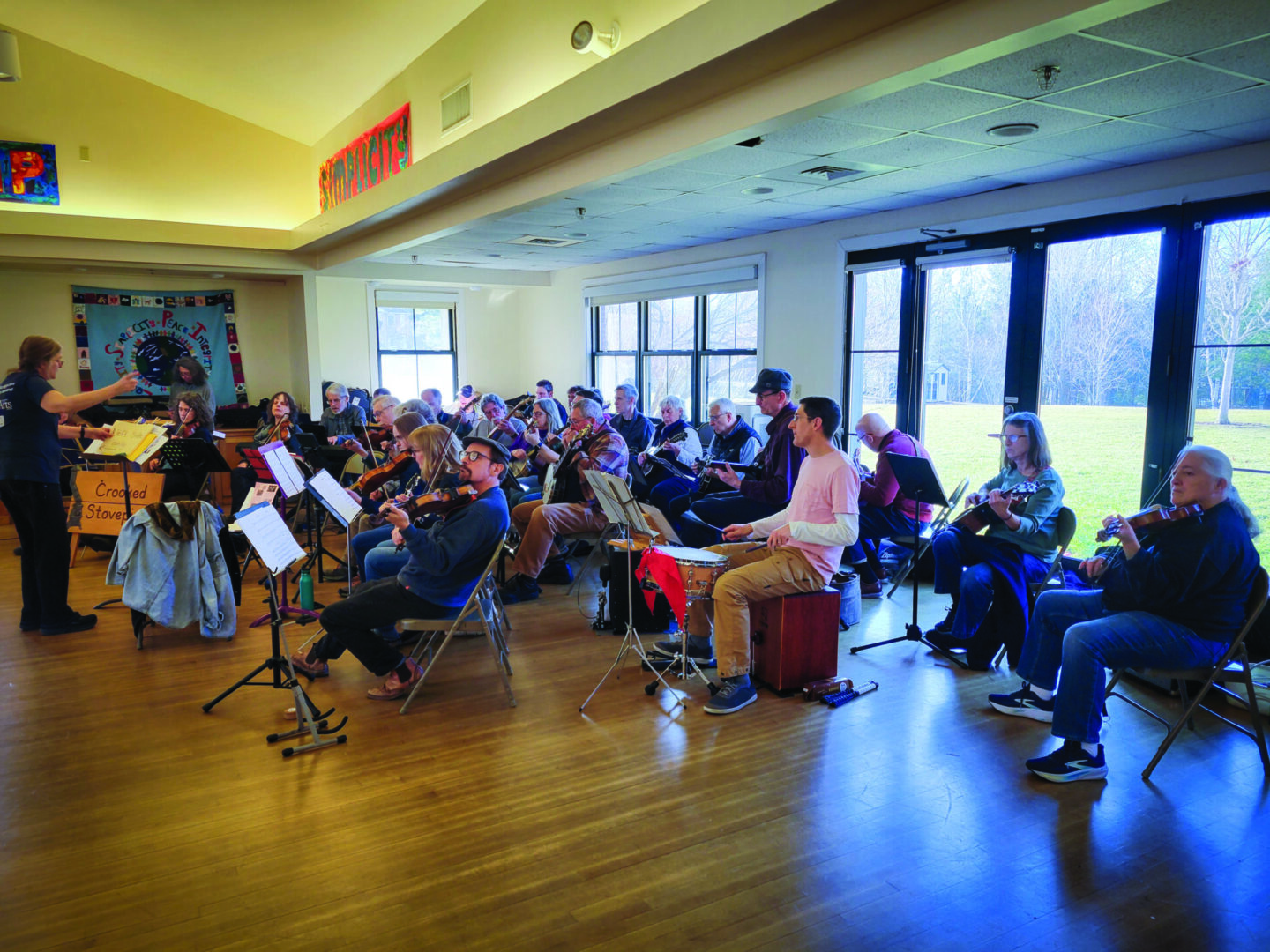
The Feb. 21 dance celebrated the rebirth of Crooked Stovepipe, the CPCDA’s original house band. Founded in 1985 with a half-dozen musicians led by John Lamancusca, the band joined caller Dick Cole in 1986 to offer regular contra dances in State College. Cole had learned contra and square dance calling in Maine before joining Penn State’s agronomy department.
For the Feb. 21 dance, original member Linda Littleton, now a member of Simple Gifts, revived the band with a new approach, “The band leader creates arrangements on the fly and tries to make it accessible to newer musicians … anyone who wants to can try it.”
The response set a new record for a local contra dance band — 29 musicians led by Holly Foy of Callanish. They played lively dance tunes — Old-Time, New England style, Appalachian, and Celtic — on piano and a mix of fiddles, guitars, mandolins, banjos, basses, ukuleles, dulcimers, and percussion.
“We’re trying to build a community of musicians who love playing together,” Littleton says, noting that the band attracted musicians from the Tuesday Night Bluegrass Jam at Pine Hall Lutheran Church, the Folk College, and local bands. Interested musicians can contact her. Crooked Stovepipe will play again for the May 16 dance.
The caller on Feb. 21, Bruce Young, played fiddle for Penn State Folklore Society square dances in the 1970s when he was a student. He later learned calling from Bill Wellington and Tony Parkes at Augusta Heritage Workshops in Elkins, West Virginia. A former CPCDA dance organizer, Young now dances, calls contras and squares, and plays fiddle in several bands.
He says dance calling is like a folk art, passed down from caller to caller. “Contra dance is meant to be accessible. It’s meant to be done by truck drivers and farmers. You don’t have to have special knowledge and training. That’s the beauty of it.”
“Kids of all ages are welcome at the dances, supervised by a parent or guardian,” Maynard says. “Kids as young as 7 or 8 can become good dancers.”
“Our aim is to make people feel comfortable, to make them feel welcome,” Alden says. “There’s this magical feeling of how you’re moving to the music — you’re expressing the music in these moves. And everyone else is doing it together with you. … You feel like you’re part of a community. It’s hard not to smile while you’re contra dancing.” T&G
Karen Dabney is a freelance writer and contra dancer in State College.